
Onsite or cloud PBX? It’s a straightforward question, but not always an easy one to answer. As a business, deciding between on-site or cloud PBX depends on your needs, connectivity, existing infrastructure, budget, security requirements and how much flexibility you need as your business grows. The right choice can have a direct impact on how reliably your team communicates, how easily you scale, and how much control you retain over your telecommunications environment.
For South African businesses in particular, factors like internet stability, branch structure and long-term growth prospects can make one more option far more suitable than the other. In this piece, we’ll help South African businesses make an informed choice by explaining everything you need to know about both PBX options, from basic definitions to the scenarios where each one performs best. Additionally, we’ll discuss hybrid solutions for businesses who need both onsite and cloud PBX. For more details on all telecommunications services listed, and others not covered here, visit TRUENAV.
Cloud PBX or Onsite PBX: What is Onsite PBX?
To understand cloud PBX, it helps to first grasp onsite PBX. This is a physical phone system set up on your business premises that offers local calling. Using SIP trunks, protocols that handle call operations, an onsite PBX can connect to public phone lines or VoIP providers. It’s highly effective, with all data stored securely, reliable internal communication even if the internet goes down, and significant customisation options for those with the technical know-how. While installing and maintaining an onsite PBX requires physical space and expertise, many South African businesses find it a worthwhile investment because of its security, reliability, and customisation potential.
Onsite PBX is especially useful for businesses that want greater control over how their phone system is configured and managed. Because the core system is housed locally, businesses can tailor features, extensions, routing rules and integrations around their own operational requirements. This can be valuable for larger offices, businesses with dedicated IT teams, or organisations that operate in environments where consistent internal communication is critical. It also gives businesses more independence from external hosting platforms, although this comes with the responsibility of managing upgrades, maintenance and hardware over time.

What is Cloud PBX?
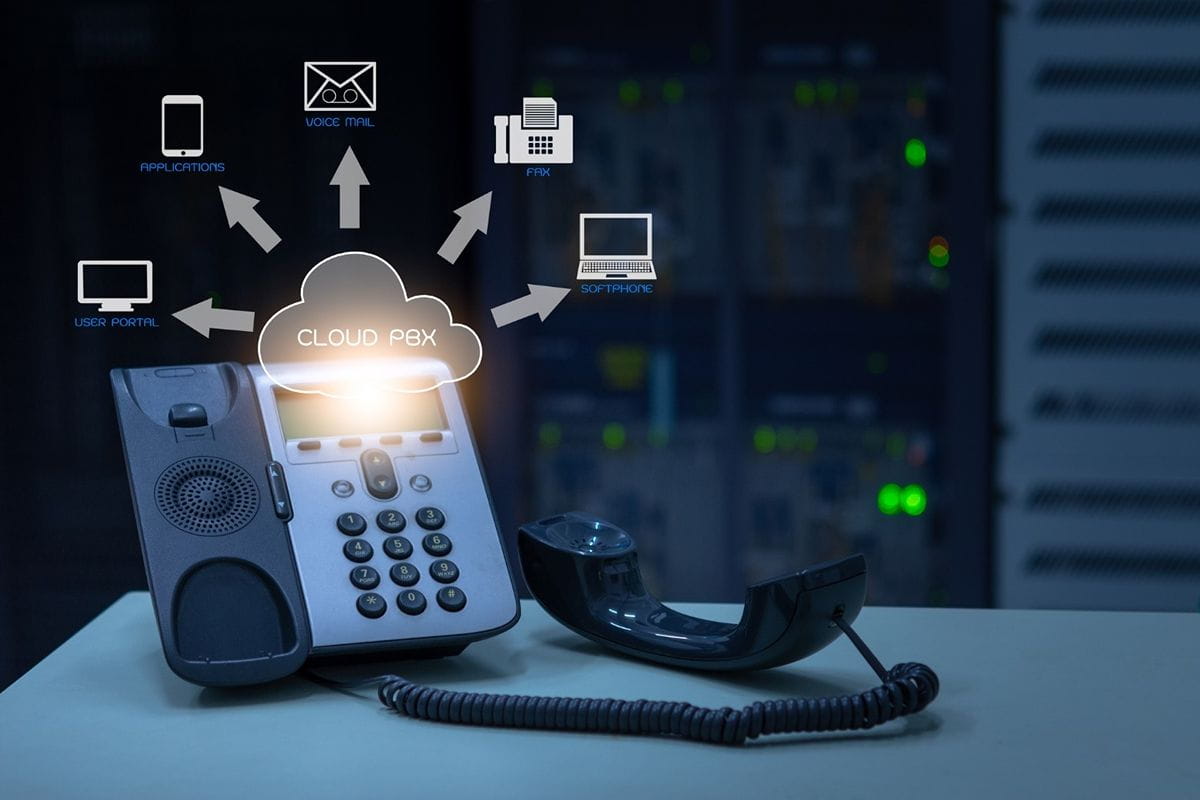
A cloud PBX system shares the same purpose as an on-site PBX: connecting a business to internal and external communication lines via a private network. Cloud PBX solutions use the internet as their medium. This offers immediate advantages, such as no need for physical space. Additionally, installation is quick and almost effortless, with minimal maintenance needed afterwards.
It has become an increasingly popular telecommunications solution among South Africans for several reasons beyond those already listed above. It’s a cost-effective service with a low barrier to entry and minimal operational overhead. It’s incredibly flexible and far-reaching, allowing your business to connect with callers worldwide with great audio quality and no additional costs incurred from international communication. Finally, a cloud PBX system can be easily managed by a non-expert through a simple web browser, allowing you to avoid IT specialist fees.
Cloud PBX is especially useful for businesses with remote employees, multiple branches or plans to expand. Because extensions and users can be added without installing new hardware at every location, the system can grow alongside the business. This makes it easier to keep teams connected through one central communication platform, even when employees are working from different offices or locations.
Core Cost Considerations For South African Businesses
Cost is a major factor when choosing between options. These costs include not only the initial investment but also monthly subscriptions and ongoing maintenance. Purely on cost, cloud PBX is significantly cheaper than onsite PBX. Without the need for physical hardware, there’s no expense for expert visits to install the system, reducing upfront costs.
Additionally, lower operational expenses come from the internet’s efficiency as a communication medium, further lowering total costs. There are also no ongoing maintenance fees for system upkeep. For budget-conscious businesses, cloud PBX is an excellent choice. Conversely, those valuing security, reliability, and customisation might still prefer to allocate funds for an onsite PBX system despite its higher costs.
Reliability and Connectivity As Essentials
Business continuity is an essential trait, defined by an organisation’s ability to maintain essential functions during and after a major disruption, such as power, network or internet outages. When choosing a PBX system for your business, business continuity is certainly one of the key factors to consider thoroughly. The hands-on approach of onsite PBX systems places the responsibility for continuity with the business. You can install your own backup power systems and failover solutions, and with these measures in place and regular maintenance, onsite PBX can be remarkably resilient, maintaining internal communications even when external lines go out.
Cloud PBX comes with built-in failovers and provider guarantees, all aimed at minimising single points of failure. The greatest threat to a cloud PBX system is a total internet outage, but fortunately, TRUENAV offers an easy solution. We provide dedicated internet provision services designed to work alongside our telecommunications services, making sure they remain operational at all times. This offers outstanding business continuity even when using a system traditionally vulnerable to connectivity issues. Of course, in areas where connectivity can’t be guaranteed, an onsite PBX system may make the most sense.

Scalability and Flexibility Create Resilience
If you’re a South African business with a fast-growing service or operating within a strongly seasonal industry, scalability and flexibility will both be very important. Scalability is defined by a system’s ability to grow with ease, adapting to increased traffic without losing functionality or efficiency. A scalable service in the telecommunications world is one that can effortlessly add or remove users, support multiple branches under one package, and adapt to a business’s overall needs as it grows.
If this sounds like your business, a cloud PBX system is more than likely the right choice. It’s fast and flexible, able to operate at speeds only possible with services independent of physical hardware. It can be adjusted in nature and scale at the press of a button, allowing South African businesses to adapt as situations change before their eyes. TRUENAV offers a wide array of packages for you to choose from, letting you add or remove features as the environment demands.
Security and Control Concerns
Security and control will always remain essential matters to both businesses and telecommunications providers like TRUENAV, who are aware of the consequences of any lapse in quality in these departments. Cybercrime is a growing phenomenon, robbing businesses worldwide of billions every single year, and always finding new ways to do so. Cybersecurity needs to not only match but exceed that level of innovation, developing techniques that safeguard data at any cost.
With onsite PBX, most security responsibilities fall to the business itself as the physical holders of the system. That being said, the physical nature of the onsite PBX system makes it highly secure from outside incursion, with the scope of possible attacks being much smaller. Because of the online nature of a cloud PBX system, it is more exposed to fraudsters and cybercriminals. Fortunately, TRUENAV has implemented serious security measures around all our digital services, constantly updating them to ensure top-level encryption and firewall protection.
Whether you opt for onsite or cloud PBX from TRUENAV, you can rest easy knowing your data is secure and safe.
Which South African Businesses Benefit Most From Each?
There is no single superior PBX system when choosing between onsite and cloud alternatives. Both have their pros and cons, ultimately making each suited to different scenarios rather than outright placing one above the other.
Onsite PBX may be more expensive up front, require more maintenance and be less flexible, but it offers strong security, puts the power of management in the hands of the business and can be highly reliable where internet connectivity is poor. This makes it ideal for hotels and resorts, which integrate physical desk handsets in all of their guest rooms. It’s also great for heavy industrial factories where the internet is unreliable, allowing them to maintain communications through their business by using durable physical hardware. Moreover, financial, legal and even government organisations value the added security facilitated by an onsite PBX system.
On the other hand, businesses with hybrid or remote teams couldn’t exist without the long-range reach and low costs offered by cloud PBX systems. They need a system that offers an easy and affordable way to connect with staff distributed throughout the world, providing a professional standard of communication at all times, anywhere. Further, small businesses and startups with tight budgets truly appreciate the low barrier to entry offered by a cloud system’s affordable rates and operational costs. Finally, sprawling enterprises with multiple branches scattered throughout the world benefit from a cloud system’s ability to create a low-cost, broad-range communications system with a central digital point.
Why Many South African Businesses Are Choosing Hybrid PBX
If you’re unsure whether to choose onsite or cloud PBX systems, TRUENAV offers an ideal solution. Our hybrid PBX systems leverage the advantages of both types, working together to provide security, customisation, international reach, and flexibility. They also feature a strong business continuity plan: in case one system is disrupted, traffic automatically reroutes through the operational system, ensuring minimal service interruption.
This setup enables your business to navigate any disruption smoothly, with users hardly noticing the change. By merging the strengths of legacy and modern networks, a hybrid system presents a forward-thinking, reliable option for South African businesses.
Final Thoughts on Onsite and Cloud PBX
There is no definitive winner in the comparison between an onsite and cloud PBX system. The more traditional onsite system may require a more hands-on approach with a larger financial investment attached, but it stands out as a highly secure and reliable solution that also allows for a great level of control from the business. Modern cloud systems operate independently of any physical hardware, bringing low costs, flexibility, scalability and the ability to connect callers from anywhere in the world.
Which of these two works best for you depends on your business, the environment in which it operates and the demands it must meet. As an easy solution, you could instead invest in a hybrid PBX system. This gives you access to the benefits of both systems while also offering an advanced level of business continuity.
To reap the benefits of onsite, cloud or hybrid PBX systems, get in touch with TRUENAV today and speak to one of our experts.